
Understanding Project Management Outsourcing Project management outsourcing refers to the practice of delegating project management responsibilities to an external provider, allowing businesses to leverage specialized skills and resources that may not be readily available internally. This approach operates through various models, including Business Process Outsourcing (BPO), which focuses on transferring entire work processes or functions to third-party experts. By outsourcing project management, organizations can ensure that their projects are handled efficiently and effectively without straining their internal teams. The significance of project management outsourcing in today’s business landscape cannot be overstated. As organizations strive to remain competitive in a fast-paced global economy, they often confront the challenge of limited in-house expertise or resources. Outsourcing to the Philippines, for instance, has gained popularity due to its skilled workforce, cultural compatibility, and cost-effectiveness. Such regions have emerged as prime destinations for businesses seeking to outsource specific functions of their project management. Several key reasons compel businesses to outsource project management. Primarily, it allows for a greater focus on core competencies, as internal teams can channel their efforts towards strategic initiatives while external experts manage projects. Additionally, it enhances flexibility and scalability, as the outsourced provider can adapt resources according to the project’s changing demands. By engaging a reliable partner like Tru29, companies can gain access to cutting-edge project management practices, ensuring better outcomes and reduced risks. Overall, understanding the mechanics and advantages of project management outsourcing is essential for businesses looking to enhance their operations. The evolving nature of the business environment signifies that outsourcing is not merely an option, but increasingly a necessity for maintaining competitive advantage. Key Benefits of Outsourcing Project Management Outsourcing project management has become a strategic decision for many organizations aiming to enhance their operational efficiency. One of the primary benefits of this approach is cost savings. By outsourcing to specialized firms like Tru29, businesses can reduce overhead costs associated with maintaining an in-house project management team. This is particularly beneficial for small to medium-sized enterprises (SMEs) that may not have the budget or resources to support a full-time staff dedicated to project management. Another significant advantage is access to specialized skills. When companies outsource project management, they tap into a pool of talented professionals who possess the necessary expertise and experience to drive projects to success. This is especially pertinent in industries where project management methodologies and tools are continuously evolving. By leveraging external expertise, organizations can ensure that their projects are managed using the latest best practices and technological innovations. Additionally, outsourcing allows businesses to maintain a strong focus on their core operations. By delegating project management responsibilities to a trusted partner like a business process outsourcing (BPO) provider, companies can allocate more time and resources to activities that directly contribute to their growth and profitability. This enhanced concentration on core functions can lead to improved performance across the organization. Moreover, effective risk management is another substantial benefit of outsourcing. Professionals in project management are trained to identify, assess, and mitigate risks throughout the project lifecycle. By outsourcing these tasks, companies enhance their ability to navigate uncertainties, ensuring that potential issues are addressed promptly and effectively. This proactive approach ultimately leads to increased efficiency and productivity, affirming the advantages of embracing outsourcing in today’s competitive landscape. Why Choose Tru29 for Project Management Outsourcing When it comes to project management outsourcing, Tru29 stands out as a reliable partner with nearly two decades of extensive experience across various industry verticals. This wealth of knowledge allows Tru29 to understand the nuanced demands and challenges that different sectors face, ensuring that your projects are managed with a level of expertise that is hard to match. The company has successfully delivered numerous projects, demonstrating a strong track record that highlights its commitment to excellence in business process outsourcing (BPO). This history of success positions Tru29 as a preferred choice for organizations looking to enhance their project management capabilities while saving time and resources. By outsourcing to the Philippines, where Tru29 is based, clients can take advantage of a skilled workforce that is well-versed in the latest project management methodologies and tools. Moreover, partnerships with Tru29 mean access to a team that is not only adept at delivering results but also at anticipating the needs of your business throughout the project lifecycle. This proactive approach ensures that potential issues are addressed before they escalate, thereby maximizing project efficiency. Tru29’s emphasis on continuous improvement and innovation further reinforces its standing in the field. In conclusion, choosing Tru29 for project management outsourcing provides businesses with a partner that combines vast industry experience, a strong reputation for reliability, and a commitment to successful project delivery. By outsourcing your project management needs to Tru29, you can focus on your core business while enjoying peace of mind knowing that your projects are in capable hands. Conclusion: The Future of Project Management Outsourcing In the contemporary business landscape, the strategic choice to outsource project management can offer a plethora of advantages. As explored earlier, outsourcing not only enhances operational efficiency but also allows businesses to leverage specialized skills and resources that might be absent in-house. A proactive partner in project management, such as Tru29, can facilitate improved productivity and focus on core competencies, leaving detailed project oversight to experts in the field of business process outsourcing (BPO). The growing trend of outsourcing to the Philippines highlights a shift towards recognizing the value of international partnerships. Companies are increasingly turning to seasoned professionals, proficient in project management, to help navigate the complexities of their operations. This is particularly relevant in industries where rapid innovation and market responsiveness are critical. As organizations face the pressure to streamline processes and reduce costs, the demand for effective BPO strategies will undeniably escalate. Moreover, the future of project management outsourcing seems to be intertwined with advancements in technology. The integration of digital tools and platforms facilitates seamless collaboration, enabling teams to operate across borders with ease. This digitization trend not only enhances communication but also improves the overall management of projects,

Essential Outsourcing Terminologies: A Comprehensive Guide
Introduction to Outsourcing Terminologies Outsourcing refers to the practice of contracting out business functions or processes to third-party service providers. This strategic approach is not just limited to manufacturing; it encompasses various services including IT support, customer service, and even specialized areas like data annotation and image annotation. As businesses increasingly globalize, outsourcing has surged in popularity, particularly in markets like business process outsourcing (BPO), call centers, and contact center solutions. Understanding outsourcing terminologies is crucial for companies seeking to leverage these services effectively. Clear communication is essential when establishing partnerships with external providers, and a grasp of specific terms such as staff lease and seat lease aids in navigating these relationships. These terms help delineate the responsibilities and expectations of each party involved, thereby fostering a cooperative environment conducive to mutual success. Furthermore, with the rise in demand for virtual assistants and remote workers, and the expanding scope of IT outsourcing, the glossary of outsourcing terminologies continues to evolve. Accurate comprehension of this vocabulary not only facilitates smoother interactions but also empowers businesses to make informed decisions regarding outsourcing initiatives. By integrating this knowledge, companies can enhance operational efficiency, focus on core competencies, and ultimately improve their service delivery in a competitive marketplace. Outsourcing Definition: What Does It Mean? Outsourcing is a business practice that involves delegating certain tasks or functions of an organization to external service providers. This strategic approach allows companies to focus on their core operations while leveraging the expertise of specialized providers in different industries. The practice of outsourcing encompasses a variety of activities, ranging from information technology (IT) services, such as IT outsourcing, to business process outsourcing (BPO), which often includes customer service operations like those managed by call centers or virtual assistants. There are several types of outsourcing that businesses may engage in. One common type is IT outsourcing, where companies contract external vendors to manage their technology needs, such as software development and system maintenance. Another type is manufacturing outsourcing, often seen in sectors requiring production capabilities that are cost-prohibitive to maintain in-house. Additionally, human resources functions can also be outsourced, allowing companies to benefit from expert knowledge in recruitment, payroll processing, and employee training. The significance of outsourcing in today’s business landscape cannot be overstated. Through outsourcing, organizations can reduce costs, improve efficiency, and enhance their service offerings. For example, by utilizing BPO services, a company can provide excellent customer service through a dedicated contact center, ensuring that customer inquiries are managed effectively. Similarly, the practice of staff lease and seat lease has gained popularity as flexible staffing solutions that align workforce capabilities with business needs. Furthermore, companies harness data annotation and image annotation outsourcing to improve data processing tasks, thus enhancing overall productivity. By integrating these outsourcing terminologies into their business operations, organizations can strategically position themselves for growth and success in a highly competitive market. The Importance of Understanding Outsourcing Terminology In the ever-evolving landscape of outsourcing, familiarity with outsourcing terminologies is essential for fostering effective collaboration between companies and service providers. Terms such as BPO (Business Process Outsourcing), call center operations, and virtual assistants form the backbone of conversations in this industry. A solid understanding of these terms not only enhances communication but also aids in ensuring that all parties involved have aligned expectations and objectives. The jargon associated with outsourcing can have significant implications on contracts and negotiation processes. For instance, the differentiation between staff lease and seat lease can dictate the flexibility and costs associated with hiring models. Misunderstandings regarding such terms may lead to unfavorable contract terms or unmet service expectations. By grasping these outsourcing terminologies, companies are better positioned to negotiate favorable contracts that reflect their unique needs while ensuring clarity regarding deliverables. Furthermore, the management of outsourcing relationships depends heavily on a shared language. Terminology such as IT outsourcing, data annotation, and image annotation plays a crucial role in making certain that teams are aligned and projects run smoothly. Knowledge of these terms enables project managers to effectively communicate requirements and progress with both internal teams and external providers. Without a solid command of outsourcing jargon, misunderstandings may arise, compromising the efficiency and success of the outsourcing initiative. Ultimately, investing in the understanding of outsourcing terminology fosters trust and transparency in the partnership between businesses and service providers. This investment not only smooths the negotiation process but also paves the way for long-term success in managing outsourcing relationships, thereby enhancing overall business performance. Common Outsourcing Terms Explained In the realm of outsourcing, several key terminologies are essential for understanding the landscape. Below is a list of frequently used outsourcing terms along with their definitions: Business Process Outsourcing (BPO): This refers to the practice of contracting third-party service providers to handle non-core business functions, such as payroll, customer service, or IT tasks. Call Center: A facility that handles a large volume of telephone calls, typically for customer support and service inquiries. Virtual Assistant: An individual who provides professional administrative, technical, or creative assistance to clients remotely. Contact Center: A centralized office used for incoming and outgoing customer communication via various channels such as phone, email, and live chat. Staff Lease: An outsourcing arrangement where a company leases employees from a third-party provider to perform specific tasks or projects. Seat Lease: This is an agreement where a company rents operational space and resources, such as equipment and facilities, from a third-party provider, typically for call center or BPO operations. IT Outsourcing: The practice of delegating areas of IT services to an external firm, encompassing everything from software development to network management. Data Annotation: The process of labeling data for training machine learning models, which can include text, audio, video, and images. Image Annotation: A specific type of data annotation focused on providing descriptive labels or tags to images for better recognition by AI or computer systems. Service Level Agreement (SLA): A contract that outlines the expected level of service, including quality metrics, response times, and performance standards between a service provider and a client.

Is Outsourcing in the Philippines Dying? Exploring the Evolution of the Outsourcing Industry
Understanding Outsourcing in the Philippines Outsourcing, the practice of contracting a third party to perform services traditionally handled in-house, has gained significant traction over the last two decades. The Philippines has emerged as a premier destination for outsourcing, particularly in sectors such as business process outsourcing (BPO), information technology (IT), and customer service. This growth can be attributed to a multitude of factors that have positioned the country as a viable hub for global companies seeking efficient and cost-effective solutions. One of the key drivers behind the Philippines’ rise in the outsourcing industry is its large, skilled workforce. With a high literacy rate and strong English proficiency, Filipinos are well-equipped to meet the demands of various sectors, making them attractive candidates for international companies. The cultural affinity towards Western practices further enhances their capability to engage proficiently with international clients. The government has also played a critical role in nurturing the outsourcing sector. Recognizing its economic potential, authorities have implemented policies that encourage foreign investment and provide incentives for outsourcing companies. Additionally, the establishment of special economic zones has fostered a business-friendly environment, contributing significantly to the growth of outsourcing in the Philippines. These zones are equipped with advanced infrastructure, which further facilitates the ease of doing business. In terms of the sectors most commonly outsourced to the Philippines, the BPO industry stands out prominently, encompassing services such as customer support, telemarketing, and technical support. However, the landscape of outsourcing is evolving, with increasing demand for IT-related services such as software development, data analytics, and digital marketing. Overall, the Philippines continues to be a vital player in the global outsourcing landscape, driven by its skilled human resources, supportive government policies, and a diverse range of services offered. Within this context, understanding the evolution of the outsourcing industry is essential as stakeholders navigate the ongoing dynamics of this sector. Historical Overview of Outsourcing in the Philippines The outsourcing industry in the Philippines began to gain significant traction in the early 2000s, positioning the country as a premier destination for Business Process Outsourcing (BPO). Early milestones in this sector included the establishment of the first call centers, which catered mainly to American companies seeking cost-effective solutions for customer service and telemarketing. The Philippines offered a unique set of advantages, such as a large pool of English-speaking graduates, competitive labor costs, and a favorable time zone. As the industry evolved, key developments in technology played a crucial role in enhancing operational efficiencies in outsourcing. The introduction of high-speed internet and advancements in telecommunications enabled seamless communication, which became a critical factor for international companies looking to outsource their operations. This technological progress laid the groundwork for the expansion of services beyond traditional call center operations, encompassing IT support, human resources, and creative services. By the late 2000s, the Philippines was recognized globally for its capabilities in the outsourcing sector. The government also played an instrumental role in fostering this growth by implementing favorable policies, investing in training programs, and establishing economic zones that attracted foreign investors. As a result, the Philippines saw the emergence of numerous global outsourcing firms and a steady influx of jobs, contributing significantly to the country’s economy. In the following years, the outsourcing industry faced challenges, including competition from emerging markets and changing client expectations. However, continuous innovation and adaptation helped the Philippines maintain its status as a leading outsourcing hub. To this day, the country’s adaptability and commitment to workforce development remain vital to its ongoing success in the outsourcing landscape. Current State of the Outsourcing Industry The outsourcing industry in the Philippines remains a vital component of the global economy, employing over 1.3 million Filipinos and contributing approximately $29 billion to the national GDP as of 2022. This sector has evolved significantly over the past two decades, with the Philippines establishing itself as a premier destination for Business Process Outsourcing (BPO) services. The country is particularly renowned for its customer service, technical support, and information technology outsourcing services, which cater to a diverse range of sectors including healthcare, finance, and e-commerce. One of the most notable aspects of the current outsourcing landscape is the diversification of services offered. While traditional voice outsourcing services continue to thrive, there has been a marked increase in non-voice services, such as IT services, digital marketing, and content creation. This shift is indicative of a broader trend towards value-added services that demand specialized skills, positioning the Philippines as a multifaceted hub for outsourcing. The COVID-19 pandemic significantly impacted the outsourcing industry globally, and the Philippines was no exception. Initially, the lockdowns led to disruptions and a temporary decline in operations. However, the industry quickly adapted to remote work setups, with many companies leveraging technology to maintain productivity. This adaptation not only preserved jobs but also showcased the resilience of the industry. Post-pandemic, there is an observed upsurge in demand for outsourcing services, as businesses worldwide seek to optimize costs and enhance operational efficiencies. Overall, while challenges remain, including competition from other outsourcing destinations and the rapid pace of technological advancement, the Philippines continues to thrive as a key player in the global outsourcing arena. The combination of skilled human resources, a favorable business environment, and an ability to adapt to change positions the industry on a path of potential growth and evolution in the coming years. Challenges Facing the Outsourcing Sector The outsourcing industry in the Philippines is grappling with numerous challenges that threaten its long-standing position as a global leader in this sector. One of the primary challenges is increased competition from other emerging outsourcing countries. Nations like Vietnam, India, and various Eastern European countries have begun to enhance their own outsourcing capabilities, offering similar services at competitive rates. This heightened competition not only pressures Philippine companies to innovate but also necessitates the implementation of cost-cutting measures to remain viable. Technological advancements pose significant challenges as well. The rapid evolution of technology, particularly artificial intelligence and automation tools, requires outsourcing firms to adapt swiftly. Companies that fail to integrate these

Outsourcing Your Organization’s Call Center: The Smart Move
Running a successful organization requires making smart decisions that can streamline operations and improve efficiency. One such decision that many businesses are making today is outsourcing their call center function. While some may be hesitant about this move, there are numerous benefits to be gained from outsourcing. In this blog post, we will explore the top advantages of outsourcing your organization’s call center. 1. Cost Savings One of the primary reasons why organizations choose to outsource their call center is the cost savings it offers. By outsourcing, you can avoid the expenses associated with setting up and maintaining an in-house call center. This includes hiring and training staff, investing in infrastructure and equipment, and managing ongoing operational costs. Outsourcing allows you to access a team of trained professionals at a fraction of the cost. 2. Focus on Core Competencies Outsourcing your call center function enables your organization to focus on its core competencies. By delegating the responsibility of handling customer inquiries and support to a specialized call center provider, you can redirect your resources towards activities that directly contribute to your business’s growth and success. This allows you to enhance your product or service offerings, improve customer satisfaction, and ultimately drive revenue. 3. Scalability and Flexibility Outsourcing your call center provides you with the flexibility to scale your operations based on your business needs. During peak periods or seasonal fluctuations, you can easily increase or decrease the number of agents handling your calls. This ensures that you have the right level of support to meet customer demands without having to worry about overstaffing or understaffing. With outsourcing, you can adapt your call center capacity to match your business requirements. 4. Access to Expertise Call center outsourcing gives you access to a pool of experienced professionals who specialize in customer service. These experts are trained to handle various customer inquiries, resolve issues efficiently, and provide exceptional support. By partnering with a reputable call center provider, you can leverage their expertise and tap into their knowledge base to enhance the quality of your customer interactions. This can result in improved customer satisfaction and loyalty. 5. 24/7 Support Outsourcing your call center allows you to provide round-the-clock support to your customers. A reputable call center provider will have the resources and infrastructure to handle calls at any time of the day or night. This ensures that your customers can reach out for assistance whenever they need it, regardless of the time zone they are in. Offering 24/7 support can significantly enhance your brand reputation and customer experience. Outsourcing your organization’s call center function offers numerous benefits, including cost savings, the ability to focus on core competencies, scalability and flexibility, access to expertise, and 24/7 support. By making the smart move to outsource, you can improve your customer service capabilities and drive business growth. So, why wait? Start exploring call center outsourcing options today!

Understanding Shared Services: The Advantages of Outsourcing with an Operational Model
What is Shared Services? Shared services refer to the consolidation of business functions that are utilized by multiple departments or units within an organization. By centralizing operations, organizations can streamline processes, enhance efficiency, and reduce overhead costs. This model often encompasses a variety of functions, such as human resources, finance, information technology, and customer support services. Through shared services, companies can allocate resources more effectively and enable a more focused approach to service delivery. One of the primary advantages of implementing shared services is the potential for enhanced operational efficiency. When business units share common resources—such as a call center or back office administrative functions—it allows for the optimization of staff and tools. For instance, a company employing remote workers in a shared service model can benefit from a diverse talent pool while keeping operational costs low. Organizations may opt for outsourcing specific tasks, employing virtual assistants or remote admin support, to further streamline workloads and improve productivity. Another key benefit of shared services is the ability to leverage technology and standardized processes. This is particularly relevant in scenarios involving shared technologies and integrated systems that facilitate communication and data sharing among different business units. Companies that have successfully adopted these practices, such as multinational corporations or thriving startups, have illustrated that the shared services model can drive innovation and foster a collaborative environment. By implementing shared services, businesses can focus on their core competencies while enhancing overall performance through a well-structured operational framework. Ultimately, shared services provide a strategic avenue for companies seeking to elevate their operational capabilities, offering both flexibility and scalability in a competitive marketplace. The Structure of Shared Services Shared services refer to the consolidation of business operations that are used across multiple divisions within an organization. Organizing shared services requires a well-defined structure, which typically includes various roles and responsibilities designed to streamline operations and enhance efficiency. Centralizing functions like administration, customer service, and back-office operations can optimize workflow and reduce costs significantly. By adopting a shared services model, companies can better allocate their resources, achieving a balance between operational efficiency and quality service delivery. Key roles within a shared services framework often include service managers, who oversee operations, and process owners responsible for maintaining and improving workflows. Additionally, operational staff such as remote workers or virtual assistants manage day-to-day tasks, enabling organizations to focus on their core competencies. These roles work synergistically to ensure that all aspects of internal administration run smoothly, thereby supporting overall business functions. Technology plays an essential role in the structure of shared services. Utilizing advanced platforms enables seamless communication and access to shared resources, which can include call center functionalities and other administrative tasks. Technology solutions facilitate collaboration among remote teams and enhance the capabilities of remote administration. Furthermore, leveraging automation tools minimizes manual intervention, thus reducing operational complexity and increasing productivity. Integration with existing business units is a critical aspect of shared services. This involves aligning shared resources with the specific needs of each department while ensuring consistency across the organization. Common functions that companies typically centralize in shared services include finance, human resources, and IT support, all aimed at maximizing efficiency and reducing redundant efforts. Adopting a shared services model not only helps in enhancing service delivery but also empowers organizations to respond swiftly to changing business conditions, thereby supporting overall strategic objectives. Key Advantages of the Shared Services Model Shared services have gained immense popularity in the business landscape due to their ability to streamline operations and improve efficiency. One of the primary advantages is cost savings. By consolidating functions such as IT support, HR, or accounting into a shared services model, organizations can significantly reduce operational costs. This reduction is often achieved through economies of scale, allowing companies to leverage combined resources and minimize redundancy. For instance, instead of each department indulging in separate administrative functions, a centralized back office can efficiently manage these tasks, resulting in lower expenses. Another notable benefit of shared services is the enhancement of service delivery. Organizations harnessing shared services often report improved response times and service quality. With dedicated teams overseeing specific functions, such as a call center focusing solely on customer support or a remote admin team handling various administrative tasks, the quality of service provided can be greatly enhanced. This specialized attention ensures that employees can deliver their best work without juggling multiple responsibilities. Scalability is also a critical advantage of adopting a shared services model. As organizations grow, they may face increasing demands on their resources. Shared services allow for effortless scaling of operations. Whether by onboarding more remote workers or expanding virtual assistant capabilities, companies can easily adjust their service delivery to meet evolving business needs. This flexibility is paramount in today’s fast-paced market where adaptability often determines success. Lastly, enhanced operational efficiency is a hallmark of shared services. By freeing up resources from administrative burdens, companies can refocus their efforts on core business functions. This shift not only optimizes workflow but also drives innovation and growth. For example, organizations can utilize their shared services model to allocate resources towards more strategic initiatives, thereby maximizing overall productivity. In conclusion, the shared services model offers numerous advantages that can significantly benefit organizations by improving service delivery, reducing costs, and enhancing operational efficiencies. Cost Efficiency Through Shared Services Shared services have become an increasingly popular approach for organizations seeking to optimize operational efficiency and cost management. By consolidating certain administrative functions—such as call centers, back office, and admin tasks—into a unified service model, companies significantly reduce operational costs beyond just salary savings. This model allows multiple departments or locations to share resources, leading to notable financial advantages. One of the primary ways shared services drive cost efficiency is through the reduction of overhead costs. When multiple departments utilize the same shared staff or remote admin capabilities, organizations can minimize duplicated efforts and resources. For example, instead of each department maintaining a separate administrative team, a shared services model enables the allocation of one cohesive team to

The Advantages and Benefits of Outsourcing Your Call Center Operations
Introduction to Call Center Outsourcing Call center outsourcing refers to the practice of delegating customer service and support functions to third-party vendors, often located in different geographical regions. This model has gained significant traction among organizations eager to enhance operational efficiency, reduce costs, and focus on core business functions. By utilizing a business process outsourcing (BPO) strategy for their call centers, companies can leverage the expertise of multi-awarded call centers that specialize in handling customer interactions across various channels. The evolution of call center outsourcing has significantly influenced how businesses engage with their clientele. In today’s globalized economy, firms of all sizes recognize the importance of delivering exceptional customer experiences, leading to an increasing reliance on outsourcing solutions. The current trend showcases a shift from in-house customer service teams to more agile and scalable contact center operations. This transformation is motivated by the rising need for businesses to adapt to changing customer expectations while simultaneously optimizing overhead costs. Moreover, the advent of advanced technologies such as artificial intelligence and cloud computing has further facilitated the growth of outsourcing in the BPO sector. As a result, many Philippine BPO companies are becoming leading providers of call center services, offering a skilled workforce capable of managing diverse communication needs. By outsourcing their call center operations, businesses can achieve improved service levels, enhanced operational resilience, and the flexibility to scale resources according to demand. Overall, the outsourcing of call center operations presents numerous advantages, including access to a wider talent pool, better resource management, and an emphasis on increasing customer satisfaction. As more organizations embrace this approach, understanding its facets becomes crucial for leveraging its potential effectively. Cost Savings Advantages The decision to outsource call center operations can yield substantial financial benefits for businesses. One of the primary advantages of outsourcing, particularly in the context of a multi-awarded call center, is the significant reduction in labor costs. In many cases, companies that engage with a Philippine BPO company can access a highly skilled workforce at competitive wage rates compared to maintaining an in-house team. This difference allows businesses to allocate resources more efficiently while ensuring high-quality customer service. Moreover, outsourcing to a contact center helps lower overhead expenses considerably. In-house call centers often incur costs associated with recruiting, training, and retaining staff. By partnering with experienced business process outsourcing (BPO) providers, organizations can bypass these expenses entirely. Outsourcing eliminates the need for spending on employee benefits, payroll taxes, and other related costs. This streamlined approach not only fosters cost savings but also enhances operational efficiency. Another financial benefit of working with an outsourcing partner is the elimination of expenses associated with infrastructure and technology. Establishing a call center requires significant investments in equipment, software, and facilities to support the business’s operational needs. However, partnering with a BPO means that the necessary technology and physical infrastructure are managed and financed by the outsourced provider. As a result, companies are free from the burden of expensive upfront capital expenditures, allowing them to invest their savings in other strategic business areas, such as marketing or product development. Ultimately, the cost savings achieved through outsourcing call center operations not only enhance a business’s financial performance but also provide the flexibility to invest in growth opportunities. By removing the financial pressures associated with maintaining an in-house contact center, organizations can focus on their core competencies and innovative strategies for long-term success. Access to Expertise and Technology Outsourcing call center operations provides businesses with unparalleled access to specialized knowledge and advanced technology that might be challenging to attain in-house. Professional Business Process Outsourcing (BPO) companies, particularly those in the Philippine BPO sector, often employ multi-awarded call center agents who possess extensive training and experience in customer service. These agents are well-versed in managing a diverse range of customer issues, which can elevate the overall service quality delivered to clients. One of the compelling benefits of leveraging a dedicated contact center lies in the cutting-edge communication tools utilized by BPOs. Outsourced call centers typically integrate advanced technologies such as customer relationship management (CRM) systems, artificial intelligence (AI), and analytics platforms. These tools not only streamline operations but also enhance the interaction between agents and customers, resulting in increased satisfaction. By deploying sophisticated software and infrastructure, businesses can ensure that their operations remain at the forefront of service excellence. Moreover, outsourcing to a specialized Philippine BPO company presents a significant advantage in terms of cost-effectiveness. The resources dedicated to training agents and continuously updating technology systems can be financially burdensome for many companies. By opting for call center outsourcing, businesses can redirect these investments toward core functions, further optimizing resources and focusing on their primary objectives while enjoying improved service delivery. Furthermore, working with an established BPO allows for rapid scaling and flexibility to meet fluctuating business demands. As market conditions shift, a reliable outsourcing partner can easily adjust their workforce to match these requirements, ensuring continuity in customer service. In essence, access to expert staff and cutting-edge technology is a pivotal benefit of call center outsourcing, which can lead to enhanced performance and improved customer satisfaction for businesses across various sectors. Improved Focus on Core Business Activities Outsourcing call center operations has become an important strategy for businesses aiming to enhance their focus on core competencies. By delegating customer support functions to external providers, such as a multi-awarded call center or a reputable Philippine BPO company, organizations can redirect their resources and attention towards growth and innovation in their primary areas of expertise. In the competitive landscape of today’s market, companies often face the challenge of balancing operational demands with the need to innovate. This is where outsourcing, particularly in regards to business process outsourcing (BPO), proves beneficial. By allowing a specialized contact center to manage customer interactions, businesses are able to alleviate the pressures associated with maintaining an in-house team. This delegation not only streamlines operations but also enables companies to allocate their internal workforce towards more strategic objectives. Moreover, outsourcing to professionals who specialize in customer service

Celebrating Recognition: TRU29’s Inclusion in Clutch’s Global Fall 2024 Outsourcing Industry Rankings
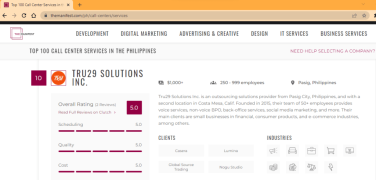
Introduction to TRU29’s Recognition TRU29‘s recent inclusion in Clutch’s Global Fall 2024 rankings serves as a significant acknowledgment of its outstanding performance within the outsourcing industry. As businesses continue to seek reliable partners for various operational needs, the importance of being recognized as a top player in the field cannot be overstated. This accolade positions Tru29 amongst other reputable multi-awarded call centers, solidifying its reputation as a premier provider of business process outsourcing (BPO) services. The ranking by Clutch, a noted reviews and ratings platform, is based on a meticulous assessment process that evaluates different parameters, including customer feedback, market presence, and service offerings. For Tru29, this recognition not only reflects its commitment to delivering exceptional services but also highlights its strategic focus on quality and client satisfaction. As companies increasingly turn to outsourcing to enhance their operational efficiency, being identified as a top call center in the Philippines is a crucial differentiator for Tru29. Tru29’s standing as a top BPO company in the Philippines underscores its role in the global outsourcing landscape. This accolade offers assurance to potential clients looking to partner with a recognized call center that can deliver reliable and effective solutions. The company’s ability to navigate the competitive nature of the Philippine call center industry, while consistently meeting and exceeding client expectations, is noteworthy. This recognition not only affirms Tru29’s market position but also motivates its workforce to continue striving for excellence. In this highly dynamic sector, excellence is often recognized, making accolades like Clutch’s rankings pivotal in establishing credibility and trust. Such acknowledgments contribute to a call center’s ability to attract new clients and retain existing ones, ensuring continued growth and success in the thriving outsourcing market. Key Call Center Services Recognized TRU29 has garnered significant recognition in the outsourcing industry for its multi-awarded call center services, which are tailored to meet the diverse needs of businesses. Each service provided by Tru29 not only exemplifies excellence but also positions the company as a leading player among top call center in Philippines. The primary call center services that have contributed to this recognition include phone support services, lead qualification, sales outsourcing, and inbound voice services. Phone support services are one of the cornerstone offerings at TRU29. They provide clients with comprehensive solutions that ensure customer queries are addressed efficiently. This service is crucial for businesses looking to enhance customer satisfaction and loyalty. The dedicated team at Tru29 employs advanced methodologies, utilizing the latest technology to create a seamless communication experience. This commitment to quality is what makes Tru29 stand out amongst other top BPO company in the Philippines. Lead qualification is another essential service where Tru29 excels. By employing a strategic approach to identify high-potential leads, the company significantly improves conversion rates for its clients. This service demonstrates Tru29’s commitment to not just meeting, but exceeding the expectations of businesses seeking partnerships to elevate their sales strategies. By engaging in thorough research and employing best practices, Tru29 ensures clients have access to qualified leads that facilitate effective sales initiatives. Additionally, Tru29’s sales outsourcing services have been recognized for driving revenue growth while minimizing operational overhead for its clients. As businesses continually seek to optimize their resources, partnering with a recognized call center like Tru29 allows them to focus on core activities without sacrificing the quality of customer interaction. Finally, their inbound voice services have received accolades for establishing a warm and professional tone in customer interactions. This personalized approach fosters deeper customer relationships, setting Tru29 apart from other competitors in the ever-evolving landscape of Philippine call center services. The Impact of Recognitions on Client Relationships In the rapidly evolving outsourcing landscape, accolades such as those from Clutch serve as a pivotal endorsement for firms like Tru29, a multi-awarded call center. Such recognition not only highlights the operational excellence of a top BPO company in the Philippines but also plays a crucial role in building trust and credibility with both existing clients and prospective partners. Businesses seeking to outsource their services increasingly rely on these rankings to assess the reputations of potential partners, as trust is a fundamental component in determining the success of their collaborations. When an esteemed organization acknowledges a company for its superior service delivery, it sends a strong message to clients that they are aligning with a capable and recognized partner. For instance, Tru29’s inclusion in Clutch’s Global Fall 2024 outsourcing rankings reinforces its stature as a top call center in the Philippines. This kind of recognition can alleviate apprehensions among clients considering outsourcing options, as it serves as validation of the firm’s competencies and commitment to quality service. Moreover, client testimonials and case studies can substantiate the value that such recognitions reflect. Feedback from businesses that have partnered with Tru29 showcase transformative results, demonstrating how the services rendered by the best call center in Manila have positively impacted their operations. These narratives not only illustrate the effectiveness of Tru29’s offerings but also provide tangible proof of its ability to meet the unique needs of various enterprises. Consequently, the impact of these accolades extends beyond mere reputation; they cement the foundation of enduring relationships built on reliability and proven performance. Looking Forward: Our Commitment to Growth As Tru29 celebrates its recognition as a multi-awarded call center in Clutch’s Global Fall 2024 Outsourcing Industry Rankings, we remain deeply committed to enhancing our service offerings and driving innovation within the business process outsourcing (BPO) sector. This acknowledgment not only underscores our achievements but also motivates us to set ambitious goals for the future. The top BPO company in the Philippines strives to cement its position at the forefront of the outsourcing landscape by continuously evolving to meet the changing needs of our clients. Our mission is to deliver exceptional customer experiences that empower businesses to thrive in a competitive market. To achieve this, we will invest in advanced technologies and employee training programs to ensure that our team remains equipped with the latest skills and industry knowledge. By fostering a culture of innovation, we

Benefits of Back Office Outsourcing
The business world is evolving at an unprecedented pace, with companies continually seeking innovative ways to stay ahead of the curve. One strategy gaining traction is the utilization of back office outsourcing services. This approach allows businesses to delegate non-core, administrative functions to external professionals. In doing so, companies can enjoy myriad benefits including heightened operational efficiency, significant cost savings, and a renewed focus on core business activities. In this comprehensive guide, we will delve into the myriad benefits of back office outsourcing, offering practical insights and recommendations for businesses contemplating this transformative step. Understanding Back Office Outsourcing Before diving into the myriad benefits of back office outsourcing, it’s crucial to have a clear understanding of what it involves. This section will elucidate what constitutes back office tasks and why businesses are increasingly outsourcing these functions to external professionals. What Constitutes Back Office Functions? In most organizations, back office functions include activities that are crucial but not directly related to core business operations. Examples of these tasks range from data entry and payroll processing to human resources and accounting. Although these functions are essential, they often consume considerable time and resources that could otherwise be deployed toward growth-centric activities. What is Back Office Outsourcing? In essence, back office outsourcing involves delegating these administrative tasks to external experts. By collaborating with back office outsourcing companies, organizations can secure skilled services without the associated overhead costs of an in-house team. The appeal of this strategy has grown across various industries, and today it’s a common practice not just for established businesses but also in startup outsourcing scenarios. Top 5 Benefits of Back Office Outsourcing Delegating these administrative tasks offers a range of compelling advantages for businesses. This section is dedicated to unpacking the top five benefits that organizations can enjoy, such as increased efficiency and reduced overhead costs, by employing back office outsourcing services. Efficient Workflow Processes When you decide to hire outside professionals to take care of your administrative tasks, one of the first things you’ll notice is how much smoother your workflow becomes. Imagine it like a well-oiled machine where everyone knows their role. These experts are trained to do specialized jobs, so they make fewer mistakes and get work done faster. What this means for you is that your entire operation runs more smoothly from start to finish. This is especially helpful for businesses that have busy periods followed by slower times. For example, if you run a retail business, you might have a huge rush during the holiday season. An company that offers outsourcing back office services can adjust its staff levels and processes to match your changing needs, so you don’t have to worry about being understaffed or overstaffed. Access to Specialized Expertise Another big plus of outsourcing back office operations is that you get to tap into a whole group of people who are experts in specific fields. These aren’t just any professionals; they specialize in areas that are crucial for your business. They bring a level of skill that you might not have within your existing team. This leads to higher quality work, which gets done faster, meaning better results for your business in the long run. For example, if you’re in the healthcare sector, an outsourcing company might have experts in medical billing, ensuring that this complex task is handled correctly and efficiently. Reduced Overhead Costs One of the most compelling outsourcing benefits is the potential for reduced overhead costs. Having full-time employees to handle back-office tasks isn’t cheap. You’ve got to think about their salaries, health benefits, and other perks. On top of that, you need space for them to work and the equipment they’ll use. When you outsource, you cut out many of these costs. You pay for the services you need when you need them. This turns fixed costs into costs that can go up or down, freeing up money that you can use for other things like launching a new product or expanding your business. Scalability If your business is growing or sees a lot of ups and downs in demand, scalability is a big deal. It’s tough to manage resources effectively when things are always changing. This is where outsourcing can be a game-changer. Outsourced services can scale up or down based on what you need. That flexibility means you can better manage your resources and concentrate on growing your main business, instead of worrying about back-office tasks. Free Up Your Resources Lastly, when you outsource, your own team can focus on what they’re really good at, which is running the core aspects of your business. This might not seem like a big deal, but it can make a significant difference. When your team isn’t bogged down with administrative tasks, they can concentrate on activities that generate income. This creates a work environment where people are doing what they’re best at, making everything run more efficiently and productively. So, in essence, outsourcing can help you put your people where they can make the most impact. Practical Insights and Recommendations for Adopting Back Office Outsourcing Taking the leap into back office outsourcing can be transformative, but it’s vital to approach it with care and proper planning. This section provides actionable tips and recommendations that will guide businesses through the crucial steps of selecting a partner, ensuring data security, and establishing effective performance metrics. Selecting the Right Outsourcing Partner – Choosing an outsourcing partner is a critical decision. Look for companies that offer a blend of expertise, scalability, and cost-effectiveness. Beyond that, it’s essential to consider the cultural fit and the provider’s adherence to compliance and data security standards. Doing your due diligence now will pay off in the long run. Establishing Performance Metrics – When it comes to benefits outsourcing solutions, performance metrics are vital. Establish clear Key Performance Indicators (KPIs) to measure the effectiveness of the outsourced functions. These KPIs should be aligned with your business objectives to ensure that the partnership yields the desired outcomes. Ensuring Data Security – Data breaches are an ever-present risk, making data security a top concern when deploying back office

TRU29 Recognized as a Clutch Global Leader for Spring 2024
TRU29 named a top B2B company for its Outsourcing services Pasig City NCR Philippines, 24-May-2024 — TRU29 Solutions Inc., today announced its recognition as a 2024 Spring Global Award winner for its Outsourcing services on Clutch, the leading global marketplace of B2B service providers. Honorees are selected based on their industry expertise and ability to deliver scores that are calculated based on the client feedback from thousands of reviews published on Clutch. TRU29 is honored to be recognized as a 2024 Spring Clutch Global Award winner. This award is a testament to the excellent client work we have delivered this year as recognized through the voice of our customers in their reviews on Clutch. We’re proud to be recognized as a Business Process Outsourcing leader on a global scale. Clutch Global Awards showcases the very best in the B2B services industry worldwide. “It is a joy to witness the incredible success of leading companies worldwide on our platform, and an even greater joy to recognize these companies as Clutch Global honorees,” said Sonny Ganguly, Clutch CEO. “Their dedication to delivering next-level services to clients has not only bolstered their own success but empowered numerous clients to thrive as well. In recognizing this spring’s Clutch Global honorees, we aim to showcase industry leaders and encourage connections for Clutch users seeking tailored services to achieve their goals.” View our recent work and reviews on our Clutch profile TRU29. ABOUT CLUTCH Clutch empowers better business decisions as the leading global marketplace of B2B service providers. More than 1 million business leaders start at Clutch each month to read in-depth client interviews and discover trusted agency partners to meet their business needs. Clutch has been honored for the past 6 consecutive years as an Inc. 5000 fastest-growing company and by the Washington Business Journal as one of the 50 fastest-growing private companies in the DC metro area for 2023.

Outsourcing to a BPO versus Freelance
In today’s competitive business landscape, finding skilled labor can be a challenge. Many businesses are turning to outsourcing as a strategy to quickly and efficiently access top-tier talent, gaining a competitive advantage in the process. But when it comes to outsourcing, what are your options? Should you consider freelance platforms or partner with a Business Process Outsourcing (BPO) company? Let’s explore outsourcing to a BPO vs. Freelance. What is Freelance? Freelance platforms like Upwork and Fiverr allow businesses to connect directly with talent, both onshore and offshore, on a contract basis. You can agree on project deliverables, milestones, and pricing, and release funds at set intervals based on the project’s progress. When outsourcing through freelance platforms, you rely on past reviews and profiles to gauge a freelancer’s suitability for your project or task. What is BPO? Business Process Outsourcing (BPO) involves delegating a business process to an external entity, which can be located onshore or offshore. There are various outsourcing models, and in the case of TRU29, oen of the ways we deliver outsourcing is through “joint management” meaning we find you the talent who work from our offices as full-time employees. We provide all the necessary IT equipment, and they report to you as an extension of your onshore team. We handle employment ancillaries such as payroll, probationary reviews, and more. With our BPO services, you pay a pre-agreed hourly or monthly fee. When to Choose Freelance? Freelance platforms are cost-effective for short to medium-term projects or one-off tasks that don’t require a full-time asset. If you don’t need to retain the intellectual property or learnings from completing the project/task, freelancers can be a great option. Freelance platforms offer quick and easy access to a wide pool of talent, and the lead time to start a project can be shorter compared to engaging a BPO. When to Choose BPO? BPO should be considered when you require permanent assets and want continuity in your operations. With BPO, you have access to dedicated human resources who work exclusively for your business, similar to an onshore employee. BPO provides peace of mind, knowing that your resources are working from a set location with local team leads and supervisors to ensure job and task performance. Additionally, BPO services often come at a flat monthly fee, which can be up to 50% cheaper than onshore hiring and generally 15-30% less expensive than hiring a freelancer. The scalability of BPO services is another advantage, allowing you to easily adjust your resources based on your business needs. Why Choose a Freelance? There are several reasons why businesses choose freelance platforms. First, the lead time to start a project can be shorter compared to engaging a BPO. Freelancers can also be a more cost-effective option, especially for project work, as they are often cheaper than engaging onshore consultancies. The user-friendly platforms make it quick and easy to access freelancers, enabling businesses to find the right talent efficiently. Why Choose a BPO? On the other hand, BPO offers unique advantages. By partnering with a BPO, you can retain your intellectual property and any investment made in onboarding and training. Unlike freelancers, BPOs provide dedicated human resources who work exclusively for your business. This ensures that your operations run smoothly and that you have peace of mind knowing that your resources are working from a set location with local team leads and supervisors. BPO services also come at a flat monthly fee, which can be up to 50% cheaper than onshore hiring and generally 15-30% less expensive than hiring a freelancer. Furthermore, BPO services offer scalability, allowing you to easily adjust your resources as your business grows. In conclusion, outsourcing through freelance platforms or partnering with a BPO can both be effective strategies for accessing talent. The choice between the two depends on the nature of your project, the need for continuity, and your budget. Freelance platforms are ideal for short-term projects or one-off tasks, while BPO services provide dedicated resources and long-term support. By understanding the What, When, and Why of BPO vs. Freelance, you can make an informed decision that aligns with your business goals and requirements. If you would like to learn more about outsourcing options, feel free to contact us through email at inquiry@tru29.com OR send us a message through our website – www.TRU29.com.