

At Tru29, we always believed that the workplace should not be very serious and dull. And yes there are a bunch of employee engagement activities every now and then but there are still times that you need to just let people do their thing like billiards, singing. etc. 😉 😉 Of course, these were done during off-hours, spare time, and breaks. One of these “own stuff” is TikTok. Let’s see these Tru29’ers that became TikTokers! Check out these T29 TikTokers via this link – https://bit.ly/3er2Prb

CocoLife and Tru29 Partnership
In pursuit of providing the best HealthCare benefits to all tru29er’s, Tru29 is proud to announce a partnership being forged with CocoLife Healthcare. CocoLife Healthcare was established in 1997 to complete Cocolife’s array of risk protection services. As the demands of the market evolved, a card-based service was introduced in 1999 in addition to its reimbursement type of health insurance. It is the first healthcare program provider certified by ISO 9001:2008 and regulated by the Insurance Commission. With its vast network of accredited hospitals, physicians, clinics, etc. coupled with its quality service, every tru29’er is assured of good quality healthcare benefits!

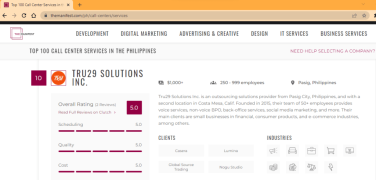
Fintech is currently one of the major growth areas for call centers in the Philippines
Fintech is currently one of the major growth areas for call centers in the Philippines. The model of many fintech operators is lean; the focus is on the technology and offering their customers finessed front-end applications that cater to most of their needs. However, wherever there are customers, there is always the possibility they will need support. And this is where contact centers in the Philippines are providing the infrastructure that allows fintech companies to grow. Outsourcing providers in the Philippines have a long history of providing world-class and ultra-secure services for the traditional finance sector. This experience combines with the country’s BPO industry’s ability to scale rapidly while providing the highest possible quality of service, positioning it as the leading destination for fintech clients who need cost-efficient solutions to manage their new customers. With agents who often speak English without a discernible accent, around-the-clock omnichannel contact centers in the Philippines can compensate for fintech that doesn’t have a Main Street presence. Outsourcing their customer support in this way allows them to provide a high level of service while they benefit from lower labor costs and not having to fund expensive in-house operations. For many, the attraction of the new challenges in the financial sector is convenience. Instead of having to handle transactions during business hours in a branch or office that might not be conveniently located, new and innovative banks allow customers to communicate in a way and at a time that suits them. Agents in the Philippines answer phone calls, respond to emails, chats, or social media inquiries whether these were sent from websites or apps, offering the customer timely and personal service. Premier call centers in the Philippines have invested heavily in AI and other various related technologies. This frequently acts as an assistant to the human agents, helping to direct and route customer contacts. A bot can gather relevant information during a phone call and direct the customer straight to the appropriate agent, saving time for the customer and maximizing the use of agent time. AI can even scan a customer’s email for keywords and give the live agent a head start on a resolution. Highly specialized contact centers in the Philippines such as TRU29 in Manila also provide a range of other services for fintech. Bringing years of experience from the traditional finance sector, they can offer expertise in areas like manual identity verification, dispute resolution, and chargeback, fraud mitigation, and investigation. The trend towards digital has been accelerating. Now that everyone has a smartphone with a fast connection and huge computing power in their pocket, they are less patient with aspects of their life that cannot match that speed. Fintech has been a key beneficiary of that trend—when someone can download an app, autocomplete an application, and snap a few pictures of their ID, why would they stand in line at a bank to open an account? Perhaps the biggest advantage that call centers in the Philippines can offer fintech is their ability to scale to meet this new and growing demand. With over 1.2 million Filipinos working in the industry and state-supported schemes to train more, this sector is well-placed to respond to new demand. Fintech has been developing for several years, and rapid growth in the sector is inevitable as consumer demands change. The BPO industry in the Philippines is a natural outsourcing destination for fintech companies, offering a viable way to match increasing demand while keeping costs low and customer satisfaction rates high.

Tru29 Solutions and Asia United Bank
With the unending community quarantines in different cities and increasing numbers of COVID-19 cases globally, also it’s better to use mobile wallets and banking apps to get things done faster (and avoid the crowd). Due to such, Tru29 wanted to add an additional layer of safety measure for all its employees and it has found a solution with Asia United Bank’s Hellomoney. With AUB’s Hellomoney Mobile App, it allowed the employees to disburse payroll for all its employee’s real-time. Aside from such, every Tru29 employee also enjoys other features and benefits such as: no initial deposit no maintaining balance no monthly fees may open an account with a single I.D. fund transfer to any local banks as well as to GCash, PayMaya, etc. pera padala (money remittance) to partner establishments like Palawan Express, Cebuana Lhuillier, and more. use in online shopping with its mastercard feature buy load pay bills deposit funds via direct deposit to any AUB branch or even at 7-11 convenience store nationwide and a lot more With this strategic partnership between Tru29 and Asia United Bank, alll Tru29 staff can now enjoy a safe and reliable payroll aside from other benefits listed above. Tru29 is committed to provide quality partnership with it’s clients and part of ensuring qualty service is taking care of its greatest asset – its staff. Every Tru29er can rest assure that Tru29 management will endeavour to continually seek areas of improvement just as it is committed to the same for all its clients globally.

Introducing Bien!
With Tru29‘s continuous growth, it’s but natural that the organizational structure grows along to cope up with the increased need for efficient business operations. In line with such, a new role has been created in Tru29 which is the Shift Manager. This role is tasked to handle all the accounts within a given shift and ensure everything is working like a clock. As such, a person with a proven track record of management and leadership honed through years of experience is required so Tru29 has chosen the best person for the job from its arsenal – Bien dela Paz! Bien boasts of two college degrees namely, accounting and computer engineering. After graduating from college, Bien started his career as an ordinary Technical Support Specialist (Call Center Agent) way back in 2005. Since then, his career has grown and he has been promoted several times exposing him to various roles in an Outsourcing organization ranging from Team Lead, Trainer to as complex as the whole BPO’s Operations Management and Business Development. These experiences allowed Bien to gain the skills that are highly sought after in the BPO (Business Process Outsourcing) industry. Bien started out n Tru29 as a Team Lead for one of its clients whom Tru29 handles Customer Service and Back Office Administration dealing with Debt Settlement and other Financial related services. From a Team Lead role, Bien quickly rose to handle the Training Division, and moving forward he has a bigger role to fill in the organization as a Shift Manager. Congratulations Bien! Keep up the good work. We are all proud of you!

Are You in Control of Your Attitude Or Is Your Attitude Controlling You!
Attitude is one of the most commonly used and yet most misunderstood words in the English language. Managers tell salespeople their attitude controls their sales. Therapists tell couples to change their attitude, and their relationships will improve. Doctors tell patients we’ve done all we can; now it’s up to you. All things being equal, the person with the best attitude will win. Other things not being equal, the person with the best attitude usually wins. You would think that anything that packs this much power would be a subject that is taught from a young age. And yet, if you asked the next ten people you meet what attitude means, you would probably get ten different answers. However, when you have a good, clear understanding of what attitude is and how attitudes are formed, it will become apparent very quickly that only a small percentage of the population is in control of their attitude. So, if you’re like most people, you have not taken control of your attitude. But if you’re not controlling it, who or what is? If not you, then who? The media, other people, and the conditions and circumstances of their life control most people’s attitudes. Of course, that’s not good since attitude has such a tremendous effect on the quality of our lives. So, let’s talk about what attitude is and how you can use this information to shift any aspect of your life. What Is Attitude? Your attitude is the composite of your thoughts, feelings, and actions: Thoughts: Your conscious mind can accept, reject, or ignore ANY idea that flows into your consciousness. Any idea that your conscious mind accepts and internalizes (consciously or unconsciously assimilates) has an effect on your physical body, as explained below. Feelings: The nature of the idea that you internalize is impressed on your subconscious mind and determines the vibration of your body. Another word for vibration is the feeling that you express. If the idea is negative, you will express negative emotions. However, if it is positive, your emotions or vibrations will be positive. Actions: The body, which is the instrument of the mind, is the only medium through which the conscious and subconscious minds working together are able to express themselves. Whatever idea is impressed upon the subconscious mind MUST be expressed through the vibration of the molecules in the body. When that vibration becomes strong, the body must move into actions that attract people and circumstances that are vibrating at the same frequency. The Environment is But Your Looking Glass Your environment can only return to you what is corresponding to what you’re sending out. And what you’re sending out is your attitude (the composite of your thoughts, feelings, and actions). The environment acts as a mirror and sends that energy right back. If you see a reflection from your environment that you don’t like, it’s your opportunity to make a new decision and to shift your attitude. If you’re not sure what your attitude is, look at your results. Attitude and results follow one another like night follows day. What I mean by that is: one is the cause, the other is the effect. If you think in negative terms (cause), you will get negative results (effect); if you think in positive terms, you will achieve positive results. Ralph Waldo Emerson reiterated that same point when he said: “A person is what they think about all day long.” The results you achieve in life are nothing more than an expression of your thoughts, feelings, and actions. If you don’t like the results you’re getting in life, change what you are sending out. Your attitude is something you have control over ALL the time. When Your Attitude Shifts, Everything In Your world Shifts As you can see, your attitude is determined by the nature of the ideas that you choose and permit yourself to internalize (or, as we often say, what you get emotionally involved with). Then, the physical expression is automatic. It doesn’t matter if the choice is conscious or unconscious. Now, you can say, “I didn’t know,” but that’s too bad; you lose. In life, there is no allowance for ignorance. It is what it is. You can’t fake it. If you are faking a smile, enthusiasm, or friendliness, people will see through your insincerity quicker than you can imagine. To get your desired results, your thoughts and feelings, or your conscious and subconscious mind, must be in harmony and that harmony will be expressed in your actions. You will be calm, focused, and genuine. So I hope you clearly understand why you should never blame another person, or conditions or circumstances for any challenge you have in life… If you are having a problem, your conscious choice is where the problem originates. The most important investment you can make in your future happiness, success, and genius is to take time each morning to set your mindset for the day. Read something encouraging and motivational, practice gratitude, meditate or visualize, read your goal card, practice autosuggestion. Create the routine that is just right for you to ensure that you start with a positive outlook and a plan to choose thoughts and ideas that send out a message that is congruent with what you want to be returned to you. Have A Super Day!

Postpandemic Outsourcing Trends for CEOs
The COVID-19 pandemic has changed many priorities and created a new reality in its wake, but it hasn’t altered the need to deploy smart outsourcing strategies. If anything, the past 12 months have underscored how critical it is for companies to effectively manage IT, service providers—those that offer digital capabilities and business process services—in order to survive a crisis and, at the same time, transform to lead in the aftermath. Moreover, the crisis has reinforced companies’ symbiotic relationships with their service providers. That’s evident from a survey that BCG conducted in the last quarter of 2020. We found that companies will continue to depend on service providers even though they will also invest more in developing in-house capabilities. The results also reflect the state of companies’ digital transformations. Contrary to the popular notion that businesses sustained all their digital transformation projects last year, the survey shows that many companies were selective about which ones they pursued. And while 76% of respondents expect to slow down some transformation initiatives during the next 24 months, 96% expect to accelerate the execution of some transformation projects. In this article, we shine a light on these findings and their implications for the future. COUNTING ON SERVICE PROVIDERS TO NAVIGATE THE CRISIS All through 2020, as the pandemic raged and governments around the world were forced to impose, and then reimpose national lockdowns, the world’s economies were paralyzed. To understand the impact of the COVID-19 crisis on outsourcing, BCG conducted a survey of 200 global companies with large IT and business-process outsourcing footprints. (See “About the Survey.”) We found that 82% of the respondents saw revenues fall, 78% faced operational challenges, and 68% had to cope with service provider-related challenges. Many companies realized that they had no option but to become more digital more quickly if they were to survive, but only those that could facilitate remote work on short notice were able to limit the impact of the pandemic on their operations. In addition to ensuring that employees working from home could operate critical business processes, such as order to cash, adroit companies shifted to online marketing, selling, and service delivery for the foreseeable future. Finding it difficult to manage these forced digital transitions on the fly, many companies turned to their service providers for support then and have been expanding their relationships with them. “We are deepening our relationships with the [service providers] that saw us through [the initial crisis],” said a CIO of a global mining company. “They’ve been supportive and particularly good. We haven’t had a major incident throughout this period.” Many companies that turned to their service providers for support are expanding their relationships with them. Many companies were forced to take unprecedented steps to survive: 79% said that they asked service providers for help in some form, such as longer payment terms (47%), price reductions (45%), or free support for more processes or additional services (41%). The CIO of a large Australian bank stated, “We talked to our service providers, telling them frankly: ‘We’re sorry, we can’t keep paying for this process.’ [But] that was only for short-term relief.” Some companies were able to cope with the crisis because of the portfolio sourcing strategies that they had adopted before the pandemic. (See Exhibit 1.) They had been distributing the services they need to offshore and onshore providers, as well as investing in building in-house capabilities. In fact, 67% focused on developing in-house capabilities, and 66% concentrated on increasing insourcing levels. These companies tasted relatively more success during the crisis than other respondents. While many companies rely on a global footprint of service providers to prevent service breakdowns, that model doesn’t factor in the possibility of a pandemic washing over the world. Service providers, particularly in outsourcing hubs such as India and the Philippines, were hit hard, although they did their best to cope. For example, a service provider in India rented an entire hotel to ensure that its employees could work in a bubble. The company provided accommodations, access to food 24-7, stable broadband connections, and, later, regular COVID-19 testing. Other service providers negotiated with local governments to ensure that power cuts to their employees’ homes-turned-offices would be limited or, at least, predictable. PUSHING AHEAD, CAUTIOUSLY, WITH A TRANSFORMATION Businesses didn’t allow the urgent to drive out the important, though. Sixty-one percent of the companies we surveyed said that they accelerated parts of their digital transformation over the course of the year, although 42% noted that they slowed down some projects. (See Exhibit 2.) Thus, the popular perception that digital transformation has only accelerated in 2020 may be misleading, with some qualifications becoming necessary to understand the ground realities. Importantly, most enterprises plan to persist with their digital transformation agenda; in fact, 96% of the companies we surveyed expect to accelerate the execution of their transformation-related projects over the next 24 months. These companies anticipate their immediate focus to be reinforcing the IT function, with more investments in cybersecurity (55%), given that people will continue to work from home; automation (49%); cloud migration to reduce costs (47%); artificial intelligence (AI), machine learning (ML), and analytics (46%); and crowdsourced innovation (35%). That focus is consistent with their pre-pandemic agendas: 80% had been concentrating on cybersecurity, 76% had been prioritizing moving to the cloud, and 72% had been focusing on deploying AI, ML, and analytics well before the crisis. However, other companies will be selective about the digital transformation projects in which they will invest in the near term. Of the 76% of companies that expect to slow some of their transformation projects, 25% are likely to reduce their investments mainly in risk management, 23% in supply chain management, and 22% in HR processes. The main reasons that these companies offered for reducing these investments in the short run were either the lack of financial resources or a reprioritization of strategic objectives (74% of respondents in both cases). As a global fashion retailer succinctly put it: “We pushed ahead with

Philippines Launched Its Covid Vaccination Program
This Monday, March 1st, the Philippines administered its COVID-19 vaccination dose and general rollout – just over one year after the first reported COVID-19 case in the country. The country launched the vaccination drive with 600,000 doses of donated Chinese CoronaVac. Health Secretary Francisco Duque III also announced that 525,600 AstraZeneca vaccine doses earlier scheduled will be delayed for “about a week,” owing to a “global supply problem.” While the vaccination launch seems like a step towards the new normal, Metro Manila will remain under the General Community Quarantine (GCQ) for the whole month of March. The decision was made despite calls from various agencies to switch to the more lax Modified General Community Quarantine (MGCQ) lockdown restriction. However, the move was supported by the World Health Organization (WHO) – with the WHO country representative Rabindra Abeyasinghe, saying that switching to MGCQ could cause an upsurge in COVID-19 cases. credits: outsource accelerator

Back Office Outsourcing Can Work Well for Manufacturing Businesses
Manufacturing is an industry that is constantly looking for ways to operate leaner and more efficiently. From production to shipping, from supply chain management to employee attraction and retention, manufacturers are always in motion and required to meet often-tight deadlines on an ongoing basis. So finding ways to save money while doing this becomes critical. One way in which some manufacturers have found success in this area and others certainly could as well, is through business practice outsourcing (BPO) in certain areas, or simply externalizing certain company functions. While this model is likely not the solution for manufacturers for their core operations such as the production floor or research and development, it absolutely can work with back-office functions, such as payroll, human resources, and accounting. By repositioning these areas with BPO, the day-to-day operations of the manufacturing company can be better managed. Outsourcing these types of financial or HR services can actually go a long way toward helping manufacturers focus on their goals, bring more efficiencies to the overall operation, and reduce overhead costs. BPO can alleviate workload and time-consuming tasks for various departments that eat into the company’s bottom line. By employing BPO in tasks such as bookkeeping, tax return processing, auditing, and year-end financial reporting, it’s one more burden taken off of the manufacturer and allows for better concentration on what the business does best—developing, producing, and shipping products to its customers. Manufacturers best poised to take advantage of BPO are those either in the start-up phase of operation or those who function as suppliers for larger companies. In the case of the former, with a fledgling manufacturing business, why devote resources at the outset to creating internal finance and HR departments, when they can be better used to getting the operation off the ground. With suppliers, many of whom are small machine or production shops, it’s a similar benefit—the expense of outsourcing these departments can be far less than creating them in-house. The bottom line in both is efficiency—a startup or supplier likely has a great idea or a great product to offer, and that is where their expertise lies and their energy should be. And that remains perhaps the most essential benefit of bringing BPO into a manufacturing business—keeping the focus on the businesses’ core competencies and doing what it does best. BPO helps to keep strategic priorities front and center while leaving the back office tasks to professionals who do that for a living—it will both save money and bring peace of mind that the operation is sound. The alternative is nowhere near as attractive—a manufacturing business that overextends itself into areas less known to it has a much greater chance of losing core focus and damaging both productivity and customer relations. No one wants that to happen, which is why BPO services make sense for manufacturing companies. In a time of increased competition and a global market where margins are often razor-thin, manufacturers are looking for every way possible to save money and invest in their company right away. Exploring BPO for back-office operations is one proven way to keep things moving in the right direction. Tru29 has a robust understanding of the changing face of back-office services. Through a partnership with us, you can be assured that you will be adding value to your business today while taking the first steps towards ensuring preparedness for tomorrow.

Recreation and Relaxation at the Workplace
Recreation and Relaxation at the Workplace The focus of a business of any size is the work and productivity levels that need to be achieved in order to reach and exceed targets. A company’s success rate often depends on the team of people at the helm, and the motivation and momentum of staff always has a direct impact on how quickly the business moves forwards, expands, and profits. Therefore, it’s crucial to ensure that your employees have all they need in the workplace, to thrive and do their job to the best of their ability. Alongside the correct equipment, tools, and support; your staff will need to be allowed to relax, revive, and recuperate themselves for set periods of time throughout their working day. Eating their snacks or lunch at their desk can make them feel overwhelmed and overworked. Therefore, it’s crucial that you provide a space away from the work environment, where your team can switch off somewhat, and regain the energy to get back to work again. The following are some ideas and inspiration for business owners who want to create a haven in their workplace, where staff can really chill-out. A Place Like No Other Obviously, the chill-out space, or room, will be a little bit like the rest of the office, as they’ll be in the same building. However, it’s vital that you separate the environment clearly so that your staff feels like they’ve actually escaped a little. You can have some more fun with the decor, and make the most of creative color palettes and prints. The point is to be as light-hearted and chilled-out as possible, so bear that in mind when it’s time to decorate and accessorize. Keeping It Comfy If your team has been sat at a desk, on a desk chair for most of the day; they’ll want something more comfortable to relax on. Therefore, it’s worth investing in comfortable seating for your chill-out zone, and ensuring your employees can truly relax. Giant bean bags are great for sinking into, and they also provide the space with a sense of laid back fun. A quality sofa and plenty of cushions will allow those who prefer to sit-up a bit more, to enjoy a softer seat. Don’t forget a table and chairs too; many people prefer to eat, read, and chat at a table, so it’s worth providing them with space. Homely Touches Again, anything that can separate the chill-out space from the rest of the office or studio, is a great thing. Therefore, think about the little homely touches that will keep it fresh, stylish, and cozy. Plants and fresh flowers will make a great addition to surfaces, the floor, and window ledges. Festoon or string lights provide a cozy and snug touch, that will help people unwind with ease. As long as you ensure that space is kept clean and tidy; your team will benefit from the time they spend there, which will boost their productivity for the rest of the working day. In designing a workplace, the most important thing is to make sure that it’s engineered for productivity. This can mean many things, and in fact, we’re still learning about how to optimize space for this purpose. Given an office carefully designed to accomplish this purpose, however, the next thing to think about is how to keep employees relaxed and happy. This isn’t simply a nice thing to do but actually plays into maximizing productivity. Happy, relaxed employees are less likely to give in to stress and more likely to put their energy to good use during the hours when they’re actually working. It’s for this reason that some modern workplaces are providing employees with lounge-like areas where they can relax. These “chill spaces” are meant to feel separate from the actual office space, such that they allow people to disconnect during breaks or over lunch and recharge, to some extent, rather than eating or taking a few minutes off at a desk. All in all, it’s believed that providing a chill space reduces employee stress and, as a result, boosts productivity. In addition to a chill space though, it can also be a productive idea to design more of a recreation area, where employees can achieve the same healthy disconnect from work for 20 or 30 minutes at a time, but can also have a little bit of fun and bond a little bit with co-workers.